
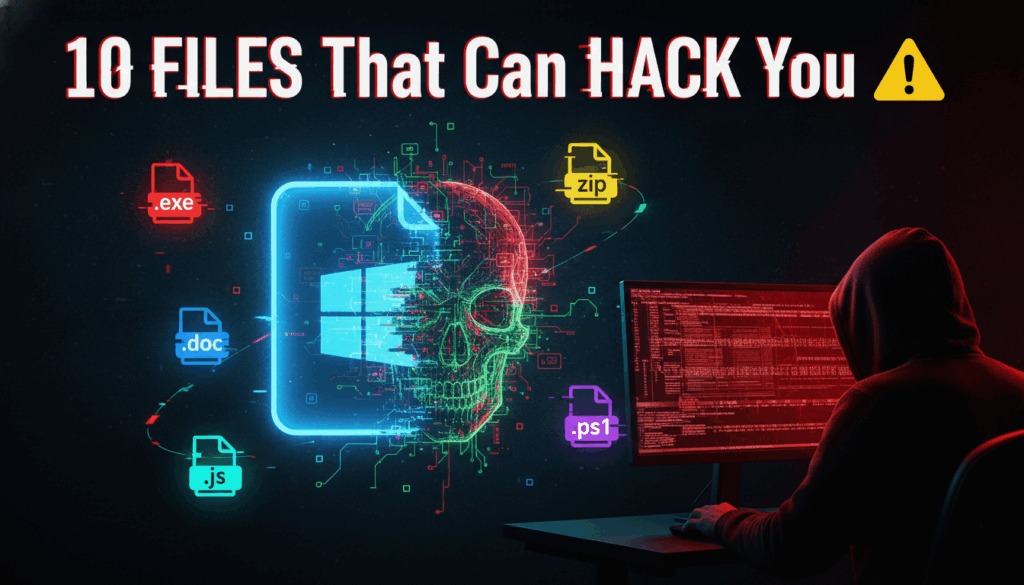
A Silent Threat Behind Every Click
The video opens like a whispered warning.
Every time we open a file — every click we trust — we invite a question we rarely stop to ask: What’s really inside? Most of us believe danger exists only in obvious executable files, the infamous .exe. But the video reveals a darker truth: modern attackers are far more subtle. They hide malicious code in everyday documents — Word files, shortcuts, scripts, compressed folders. The familiar becomes the weapon.
Unmasking the Invisible
A rapid sequence exposes ten common file types used to infiltrate systems.
What appears harmless — a document, a shortcut, a ZIP file — can trigger chaos with a single double-click. Convenience, once a luxury, has become the hacker’s greatest advantage. The viewer begins to feel a tension: if everything we open could be a trap, how can trust survive in a digital world built on speed?
A Better Way — Intention Over Assumption
Then the narrative shifts — from fear to empowerment.
Instead of uncontrolled automation, Linux is introduced as a philosophy: nothing runs without permission. Computing becomes intentional again. Transparency replaces uncertainty.
This idea expands from personal computers to the cloud: privacy should not be rented from someone else’s servers. The video questions the modern tech industry — the hidden cost of “free” convenience, where personal data becomes fuel for AI models.
Resolution — Reclaiming Freedom
Finally, a vision emerges:
A private, isolated, encrypted cloud.
AI that serves you — not corporations, not advertisers. A system built not to exploit your data, but to protect your freedom.
The video closes with an invitation:
The shift toward privacy-first technology has already begun. Will you take part?
🔑 Key Insights & Takeaways
- Danger hides in plain sight: malware isn’t just in .exe files — it hides in documents, scripts, and compressed archives.
- Convenience creates vulnerability: one careless click can launch hidden code.
- Linux represents intentional computing: nothing executes without explicit permission.
- Public clouds aren’t always safe: your data can be fed into AI models without true transparency.
- Privacy is not paranoia — it’s ethics: protecting data is foundational to digital freedom.
- A new paradigm is rising: isolated, encrypted private clouds powered by ethical AI.
- Call to action: learn, explore, or partner to embrace privacy-first computing.